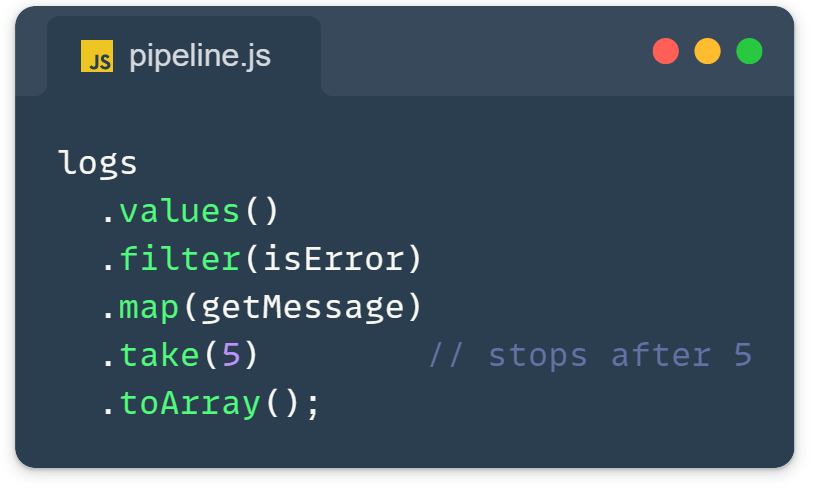
Say you’re scanning a huge log for the first five errors. A normal array chain builds a full copy of the data at every step before handing you those five. JavaScript iterator helpers flip that around: the same readable chain, but each value moves through the pipeline on its own, and the work stops the moment you have enough.
Huge log for the first five errors. A normal array chain builds a full copy of the data at every step before handing you those five. JavaScript iterator helpers flip that around: the same readable chain, but each value moves through the pipeline on its own, and the work stops the moment you have enough.
Why Array Chains Waste Work
const firstErrors = logs
  .filter(line => line.level === 'error') // full copy of every error
  .map(line => line.message)              // full copy of every message
.slice(0, 5); // keep 5, drop the restThe answer is five strings, but JavaScript read every line and allocated two full arrays to get there. That’s harmless at ten lines and noticeable at a million.
How JavaScript Iterator Helpers Work
Call .values() on the array to get an iterator, then use method names you already know. take() stands in for slice(), and toArray() turns the result back into an array.
const firstErrors = logs
  .values()
  .filter(line => line.level === 'error')
  .map(line => line.message)
  .take(5)
.toArray();Think of an assembly line. Array methods process the whole pile at each station before passing it on. Iterator helpers send items down the belt one at a time and shut the line off the moment the order is filled. Nothing starts until toArray() asks for the first item, and once take(5) has five, the rest of the log is never read.
The easiest way to see the difference is to log the order the callbacks run in:
[1, 2, 3].values()
  .map(n => { console.log('map', n); return n; })
  .filter(n => { console.log('filter', n); return true; })
  .toArray();
// map 1, filter 1, map 2, filter 2, map 3, filter 3With plain array methods you’d see map 1, map 2, map 3 first, then all the filters.
What You Can Call Them On
Anything that inherits from Iterator.prototype, not just arrays. That includes generators, Map and Set iterators, and the result of matchAll().
const emails = text
  .matchAll(/[\w.]+@[\w.]+/g)
  .map(match => match[0])
  .take(3)
.toArray();For an iterable or iterator-like object that doesn’t inherit from it, wrap it with Iterator.from() first.
Use map and flatMap to transform, filter, take, and drop to trim, and toArray, reduce, forEach, find, some, or every to finish. The transform and trim methods return another iterator, so they chain. The finishing methods end the pipeline. More helpers are on the way, and Iterator.zip is one of the features coming in ES2027.
Sources That Never End
Because nothing runs until it’s asked for, a source no longer has to finish. A generator that loops forever is just another collection.
function* fibonacci() {
  let [a, b] = [0, 1];
  while (true) {
    yield a;
    [a, b] = [b, a + b];
  }
}

fibonacci()
  .filter(n => n % 2 === 0)
  .take(5)
.toArray(); // [0, 2, 8, 34, 144]An array can’t hold infinitely many values, but a lazy pipeline only produces what take(5) asks for.
Gotchas Before You Switch
- Callbacks run interleaved. As the demo above shows, each value goes through the whole chain before the next one starts. If your callbacks log or mutate something, the order differs from the array version.
- An iterator is single-use. Once a pipeline is consumed, it’s empty: call
toArray()a second time, and you get[]. If you need the result twice, keep the array.
- Measure before you rewrite. Helpers skip the intermediate copies but add a little overhead per item, so on small arrays you read to the end, plain array methods can win. The payoff comes with large inputs, early exits like
take,find, orsome, or a source that’s expensive to produce. - Sync only. The helpers that shipped in ES2025 work on synchronous iterators. For async generators and streams, stay with
for await...of.
Browser Support for JavaScript Iterator Helpers
Baseline marked iterator helpers as newly available in March 2025. In practice, that means Chrome and Edge 122+, Firefox 131+, Safari 18.4+, and Node.js 22+. The MDN Iterator reference has the full compatibility table, and core-js and es-shims offer polyfills for older targets.
JavaScript iterator helpers won’t replace every array chain, but when you only need the first few results from a lot of data, they let your code do only the work the answer needs.